Go straight to the words

Conversation Twelve

Sleep Was Probably the First Thing to Go

A Conversation about the nights, and how rarely anyone asks about them properly.

I’d like to ask you about your nights, and I’d like to ask about them properly, which almost nobody does.

Not how are you sleeping, asked with a hand already on the door. That question has one acceptable answer and everybody knows it: not great. Then the conversation moves on.

I mean the actual night. What time you go up. How long you lie there. Whether it’s falling asleep that’s difficult or staying asleep. Whether you wake at a particular hour — and a great many people I speak with say the same hour, somewhere between two and four, as though the night has a scheduled appointment.

Whether you wake because of pain, or wake first and then notice the pain arriving. Whether you’ve been sleeping somewhere other than your own bed. Whether you have arranged pillows into a structure you would be a little embarrassed to describe.

Whether you get up at some point and read, or watch something, because lying there had become worse than being awake.
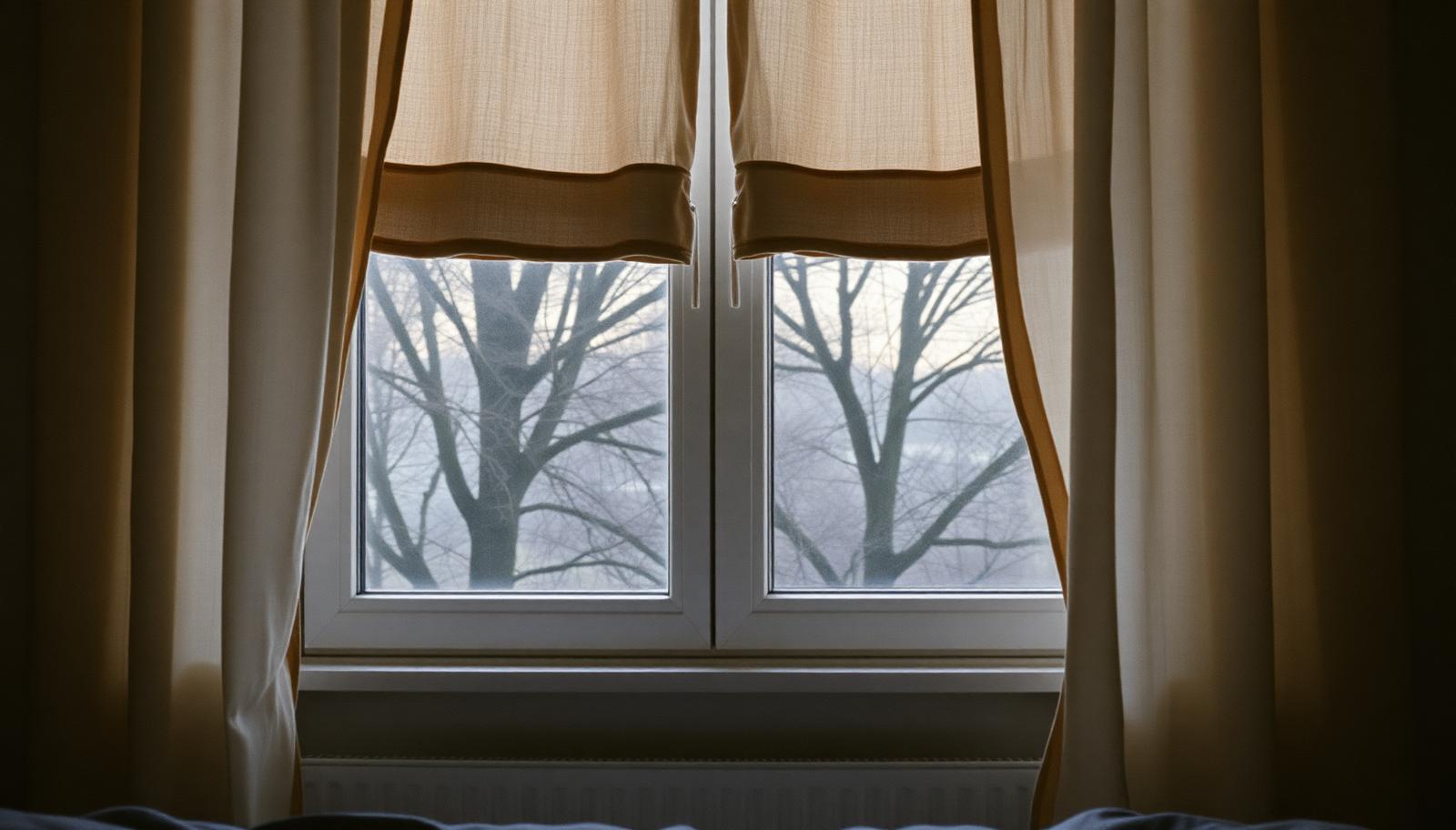
A bedroom window at first light with pale linen curtains half drawn

Here is what I’ve noticed, and it took me a long time to see, because it hides in the way the story gets told.

Sleep is almost never offered as part of the problem. It arrives later, as an aside, usually with an apology attached — well, I haven’t slept properly since about 2019, but that’s just me.

And when we go back further, the bad sleeping usually turns out to have started before the pain did. Sometimes years before. A stretch of shift work. A baby, thirty years ago, and it never quite went back to how it was. A menopause that rearranged the nights. A year of caring for someone when you slept with one ear open, and the ear never learned to close again.

By the time the body started hurting, it had already been repairing on short rations for a very long while.

When did your nights stop being straightforward?

Let me explain plainly why I care about this, without turning it into a lecture about sleep hygiene, which I suspect you could deliver better than I could by now.

A body does most of its quiet maintenance at night. Tissue repair, the tidying-up that follows a demanding day, the settling of a nervous system that has been alert since six in the morning. It is unglamorous work, and it happens while you are not supervising it.

When that work gets interrupted often enough, two things tend to follow. The repair runs a little behind. And the system that decides how loudly to report discomfort becomes more sensitive — the way anyone becomes more reactive after a bad night. You already know this from the ordinary version of it: everything is harder to tolerate on four hours of sleep, including noise, including people, including your own body.

So pain and sleep end up in conversation with one another. The pain makes the night harder. The short night makes the following day louder. Neither one caused the other, and both are keeping the other company.

That is not a trap. It’s a loop — and loops have more than one place you can put a hand in.

Now, the part I feel strongly about.

I am not going to tell you to fix your sleep. Of everything a tired person can be told to do, sleep better may be the least kind, because it is the one thing you cannot do by trying. Effort is the opposite of the ingredient. Anyone who has lain there working hard at falling asleep knows exactly how that goes.

I’m also not going to suggest that if you slept well everything else would resolve. That would be a tidy promise and I don’t make those.

What I would say is that your nights belong in your story. They are not a side issue, not a personal failing, and not something to mention apologetically at the end of an appointment. If a body has been repairing on short rations for a decade, that is context — and context is what has been missing, far more often than effort.

If anything came to mind while you read — the year the sleeping changed, the hour you keep waking, the pillow arrangement, the chair you sometimes end up in — that is worth keeping with your other notes.

Not to solve. Just so it stops living in the margin of your story, where it has been for a very long time.

And if last night was a bad one, please don’t read anything else today. There is nothing here that won’t keep.

— Tammie

You may have noticed something while we were talking — the year your sleep changed, the time you keep waking, or the pillow arrangement that has somehow become its own engineering project.

You don’t need to do anything with it today. But if something came to mind that you’d like to remember, you can leave it here before you go.

Nothing here is required reading. It’s simply where this conversation came from, gathered in one place so you can see it for yourself if you’d like to.

  1. The association of sleep and pain: an update and a path forward

    Finan PH, Goodin BR, Smith MT · The Journal of Pain · 2013 · doi:10.1016/j.jpain.2013.08.007

    A review of how poor sleep and pain influence each other, and why short sleep can make pain feel louder.

Research keeps moving, and so do we. Where something here is still uncertain, we would rather say so than sound more certain than the evidence allows.

Know someone who may need these words? You’re welcome to share this Conversation.

Stay in touch with Tammie

You shouldn’t have to remember where you found something that finally made sense.

Leave your email if you’d like to hear from me when I have something I believe could genuinely help — a new free page, a practical guide, or an important Peacefully Stronger update. There is no schedule and no sequence. Some months there may be nothing at all.

By leaving your email, you’re asking Peacefully Stronger to email you about meaningful new additions. You can leave with one click at any time. Privacy.

Continue The Conversation

Only if you would like to. Nothing here expires, and nothing is expected of you.

Return to the Library

The conversation continues whenever you’re ready.

Whenever you’d like company again, the Conversations will be right where you left them.