Go straight to the words

Conversation Fifteen

The People Who Slowly Got Better

A short Conversation about how hard it is to notice something getting easier while the pain is still there.

I want to ask you something today, and then I want to explain why I asked it.

When a person has hurt for a long time, there is usually only one question left that feels honest to ask about a week. Is the pain gone. And if the pain is not gone, then the answer is no, and the week gets put down as no, and so does the month after it, and after enough of those the sentence a person ends up with is that nothing has changed.

I understand how that happens. Pain is the loudest thing in a body, and the loudest thing usually ends up doing the measuring. Nobody chose that. It just happens, the way you stop hearing a clock in a room you live in.

Here is the thing I keep running into, and it took me a long while to see it, because it hides so well.

When something in a person’s day gets easier, it stops being noticeable almost right away. It doesn’t get celebrated and it doesn’t get remembered. It just quietly becomes the way things are, and within a few weeks it is very hard to recall that it was ever any other way.

A person can honestly feel no better and still overlook something that has quietly become easier — driving somewhere, standing long enough to finish dinner, or saying yes without planning around it for two days. It rarely arrives as good news. By then it often feels like ordinary life, because it has simply become the way the day works.

I am not raising this to argue that you are better than you think you are. I don’t know your body from here. I bring it up because I think that is how change usually behaves, and it means a person can be the last one to know.

I should tell you why this Conversation is named after the people who slowly got better, because it isn’t a success story, and I’m not going to hand you one.

Over the years I have sat with a good number of people whose days became easier over a long stretch of time. Not everyone. I won’t pretend otherwise. But when I think about the ones whose days did ease, what stays with me is how little of it looked like anything.

Most of them never found the one thing. What they did, mostly, was make their choices a size smaller. A shorter walk instead of a long one or none at all. Half the garden bed. Leaving somewhere while they still felt all right, which nearly all of them disliked at first. They started noticing what their own days were telling them, usually without meaning to. And somewhere nearby there was almost always at least one person who believed them — not always a practitioner. Sometimes a husband who stopped asking if they were sure, or a friend who carried the bags without making it an event.

They did the same small things for a long time, well after it stopped feeling like it was doing anything, and none of them did it perfectly. I can’t think of one who didn’t have setbacks. A flare after a good week. A winter that seemed to undo a summer. A month they simply stopped. The setbacks didn’t turn out to be the end of anything. They were part of it.

I’m not telling you this so you will copy them. I don’t know that any one of those things caused anything, and I can’t promise you their way of going. What I can tell you is that it looked far more like an ordinary life than like a turning point. Which is part of why it is so easy to miss.
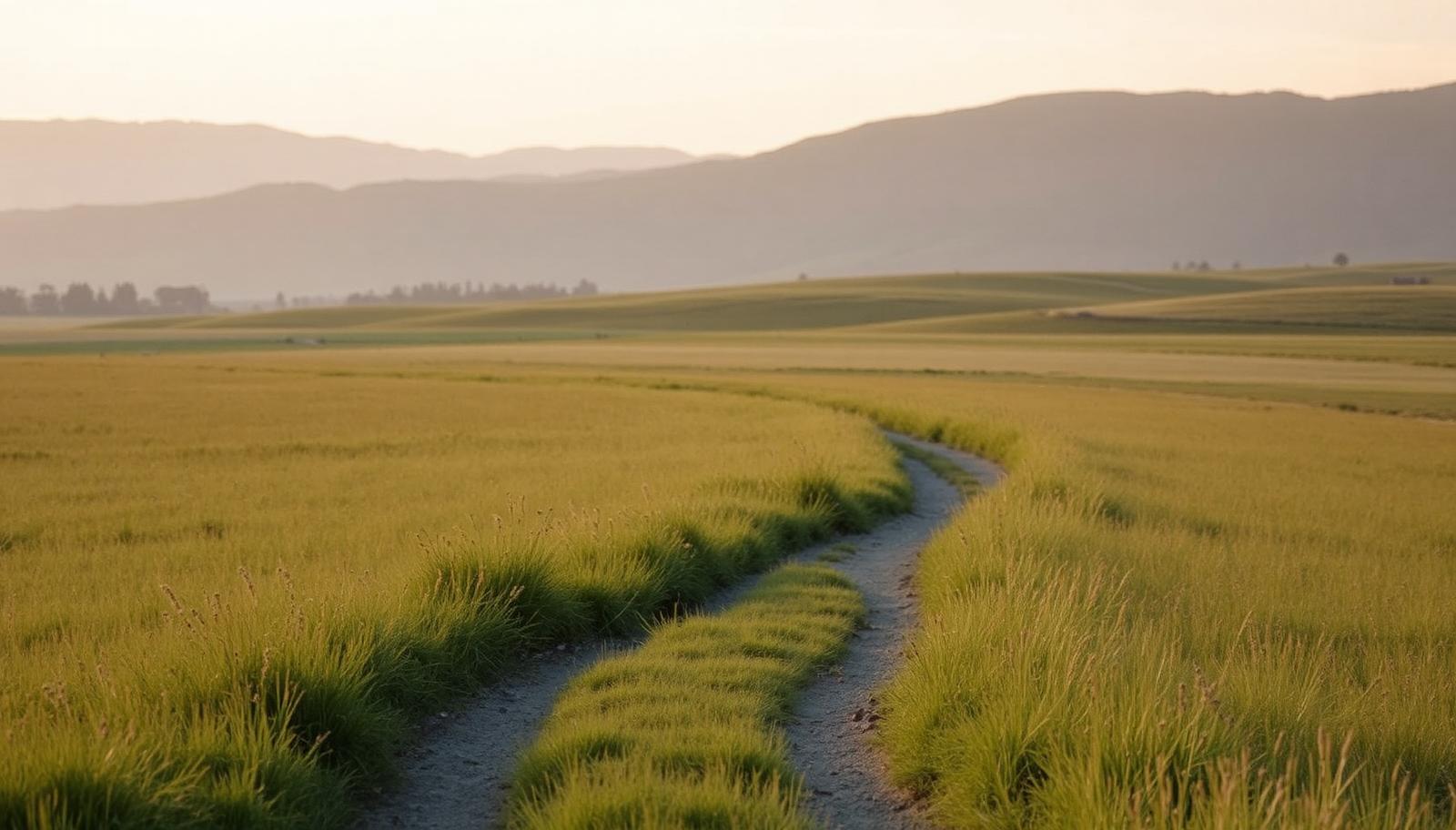
A footpath worn gently across a wide meadow toward distant hills in evening light

So here is what I would ask you, if we were sitting down together.

Is there anything you do now without thinking about it that used to take a decision?

Not something impressive. I mean the small mechanics of a day. Getting out of the car. Standing long enough to finish making dinner. Saying yes to something two days in a row. Going upstairs for one thing instead of waiting until there were three. Whether you are still sleeping in the chair.

The answer might be no. Sometimes it is genuinely no, and when a person tells me that, I take that answer at face value, the same way I would a yes. Nothing about this Conversation needs you to find something.

And here is why I ask, which matters more to me than the answer does.

The sentence a person carries about the body has a way of deciding things. If the sentence is that nothing has ever changed, then nothing seems worth trying, and every hard week confirms what was already believed. That sentence deserves to be accurate before it gets to make decisions for you. Sometimes it turns out to be exactly right. Sometimes it is only the loudest part of the truth, and the quieter part never got counted because it slipped into ordinary before anybody wrote it down.

I want to be careful here, because this is the kind of thing that gets misused.

I am not suggesting that you talk yourself into feeling better, or that pain is a matter of attention, or that noticing the good parts is a treatment. It isn’t. If something is new, or getting worse quickly, or waking you in a way it didn’t before, that deserves a proper look from someone who can examine you, and none of this is a reason to wait on that.

I am also not asking you to be grateful for a small improvement, which is a thing people in pain get asked to do far too often and usually by someone who is not in any.

All I am really doing is asking whether the pain has been the only thing you were allowed to count.

It might turn out there is nothing else on the list. That will be worth knowing too, and it is honest information rather than a failure. But if there is something on it, even one small thing, I would rather you knew about it than went on without it.

That is all for today. Nothing to do with it, and no hurry about the answer.

— Tammie

Know someone who may need these words? You’re welcome to share this Conversation.

Stay in touch with Tammie

You shouldn’t have to remember where you found something that finally made sense.

Leave your email if you’d like to hear from me when I have something I believe could genuinely help — a new free page, a practical guide, or an important Peacefully Stronger update. There is no schedule and no sequence. Some months there may be nothing at all.

By leaving your email, you’re asking Peacefully Stronger to email you about meaningful new additions. You can leave with one click at any time. Privacy.

The conversation continues whenever you’re ready.

Whenever you’d like company again, the Conversations will be right where you left them.